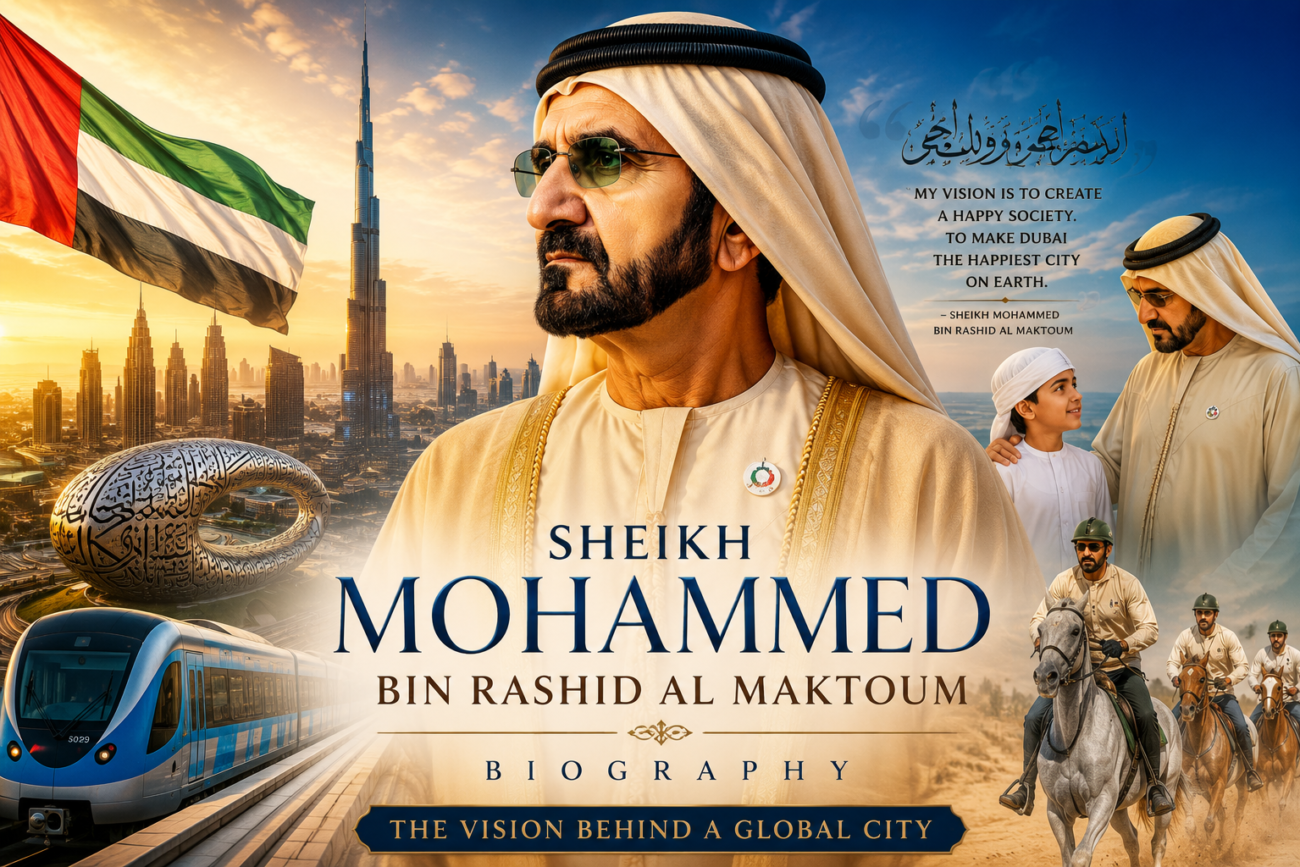
Sheikh Mohammed bin Rashid Al Maktoum is one of the most influential leaders in the modern Middle East. As the Ruler of Dubai, Vice President, and Prime Minister of the United Arab Emirates (UAE), he has played a central role in turning Dubai from a regional trading center into one of the world’s most recognized cities for business, tourism, innovation, and luxury. His leadership is associated with bold ideas, long-term planning, and a commitment to building a future-focused society.
Known for his visionary thinking, Sheikh Mohammed has consistently encouraged innovation, economic diversification, education, and technological advancement. Under his leadership, Dubai has become home to world-famous landmarks, international business hubs, and some of the largest development projects ever undertaken. His influence extends beyond politics, as he is also an accomplished poet, horseman, philanthropist, and supporter of humanitarian causes.
This Sheikh Mohammed bin Rashid Biography explores his life, education, family, leadership journey, achievements, and lasting impact on Dubai and the UAE.
Early Life and Childhood
Sheikh Mohammed bin Rashid Al Maktoum was born on 15 July 1949 in Dubai, which at that time was part of the Trucial States under British protection. He is the third son of Sheikh Rashid bin Saeed Al Maktoum, who later became the Ruler of Dubai, and Sheikha Latifa bint Hamdan Al Nahyan.
Growing up in a respected royal family, Sheikh Mohammed experienced both traditional Emirati culture and the rapid changes taking place in the Gulf region. His childhood was shaped by values such as discipline, hospitality, generosity, respect for elders, and service to the community.
Unlike many children, he was exposed to discussions about governance, trade, and regional affairs from an early age. Watching his father oversee the development of Dubai inspired him to understand leadership and public service long before entering government.
Family Background
The Al Maktoum family has ruled Dubai since the nineteenth century and has played a significant role in shaping the emirate’s political and economic development.
Sheikh Mohammed grew up in an environment where leadership was viewed as a responsibility rather than simply a privilege. His father, Sheikh Rashid bin Saeed Al Maktoum, believed that long-term planning and investment in infrastructure were essential for Dubai’s future.
This philosophy greatly influenced Sheikh Mohammed’s own leadership style. He learned the importance of making decisions that would benefit future generations instead of focusing only on short-term success.
Education
Education has always been an important part of Sheikh Mohammed’s life.
He began his schooling in Dubai, where he studied Arabic, Islamic studies, history, geography, and mathematics. Along with academic subjects, he developed a strong appreciation for Emirati traditions and culture.
As he grew older, he continued his education in the United Kingdom, gaining international exposure that broadened his understanding of economics, politics, and global affairs.
Studying abroad allowed him to observe how successful countries developed strong institutions, modern infrastructure, and efficient public services.
These experiences later influenced many of the reforms introduced in Dubai.
Military Training
One of the defining chapters in Sheikh Mohammed’s early life was his military education.
He attended the Royal Military Academy Sandhurst in the United Kingdom, one of the world’s most prestigious military academies.
At Sandhurst, he received professional training in:
- Leadership
- Strategic planning
- Crisis management
- Discipline
- Teamwork
- Physical endurance
- Decision-making
Military training strengthened qualities that would later become central to his leadership philosophy.
It taught him that successful leaders must remain calm under pressure, make informed decisions, and lead by example rather than words alone.
Even today, people admire his disciplined lifestyle and commitment to continuous improvement.
Love for Reading and Learning
Sheikh Mohammed has often emphasized that learning never ends.
Throughout his life, he has remained an enthusiastic reader of books on leadership, history, economics, innovation, and governance.
He believes knowledge is the foundation of national progress and encourages young people to read, learn new skills, and embrace change.
This passion for education has influenced many initiatives aimed at improving schools, universities, libraries, and research institutions across the UAE.
Entering Public Service
After completing his education and military training, Sheikh Mohammed began taking on responsibilities within the Government of Dubai.
His early assignments focused on security, administration, and developing government institutions.
These experiences gave him practical knowledge of how government departments operate and how policies affect people’s daily lives.
Rather than remaining distant from government operations, he preferred learning through direct involvement.
This hands-on approach later became one of the defining characteristics of his leadership style.
The Formation of the United Arab Emirates
One of the most historic moments in Sheikh Mohammed’s early political career was the formation of the United Arab Emirates in 1971.
As the UAE was being established, Sheikh Mohammed participated in important discussions that helped shape the country’s future.
The creation of the federation marked a new era of cooperation between the emirates and laid the foundation for rapid economic growth and national development.
For Sheikh Mohammed, this period reinforced the importance of unity, cooperation, and long-term planning.
Building a Modern Dubai
During the 1970s and 1980s, Dubai began expanding rapidly.
Sheikh Mohammed supported projects designed to diversify the economy beyond traditional trade and oil revenues.
He believed Dubai should become a global destination for:
- Business
- Tourism
- Aviation
- Finance
- Logistics
- Innovation
- International investment
Instead of depending on natural resources alone, Dubai invested heavily in infrastructure and global connectivity.
This vision continues to shape the city today.
Leadership Before Becoming Ruler
Before becoming the Ruler of Dubai, Sheikh Mohammed held several important government positions.
These responsibilities allowed him to oversee strategic planning, security, economic development, and major public projects.
He worked closely with his father and later with his brother, Sheikh Maktoum bin Rashid Al Maktoum.
These years provided valuable experience in administration and leadership, preparing him for future responsibilities.
Becoming the Ruler of Dubai
In January 2006, following the passing of Sheikh Maktoum bin Rashid Al Maktoum, Sheikh Mohammed became the Ruler of Dubai.
The transition marked the beginning of another ambitious chapter in Dubai’s history.
His leadership focused on accelerating economic growth while improving quality of life for residents and visitors.
He encouraged government departments to become more efficient, innovative, and citizen-focused.
Dubai continued expanding as one of the world’s leading cities for tourism, finance, real estate, and technology.
Vice President and Prime Minister of the UAE
Following his appointment as Ruler of Dubai, Sheikh Mohammed also became the Vice President and Prime Minister of the United Arab Emirates.
In these national roles, he contributes to policies affecting the entire country.
His work includes supporting economic development, improving government performance, strengthening international partnerships, and promoting innovation across federal institutions.
A Vision Beyond Oil
When Sheikh Mohammed bin Rashid Al Maktoum assumed greater leadership responsibilities, he understood that Dubai could not rely solely on oil revenues. Unlike some resource-rich regions, Dubai’s oil reserves were limited compared to neighboring emirates. Rather than viewing this as a challenge, he saw it as an opportunity to build a diversified economy capable of thriving for generations.
His vision was simple yet ambitious: transform Dubai into a global city where people from every corner of the world could live, work, invest, and innovate.
This long-term strategy focused on creating an economy driven by trade, tourism, finance, technology, aviation, logistics, education, healthcare, and entrepreneurship.
Today, Dubai’s success is often cited as one of the world’s leading examples of economic diversification.
Turning Dubai into a Global Business Hub
One of Sheikh Mohammed’s greatest achievements has been attracting international businesses to Dubai.
He introduced policies designed to create a business-friendly environment by reducing bureaucracy, improving infrastructure, and encouraging foreign investment.
Over the years, thousands of multinational companies established regional headquarters in Dubai because of its:
- Strategic location
- Modern infrastructure
- International airports
- Advanced seaports
- Stable economy
- Efficient government services
- Skilled workforce
- Global connectivity
As a result, Dubai became one of the Middle East’s most important commercial centers.
Building a World-Class Aviation Industry
Sheikh Mohammed recognized that transportation would play a critical role in Dubai’s future.
Under his leadership, Dubai invested heavily in aviation infrastructure, expanding airports and supporting the growth of one of the world’s most respected international airlines.
Today, millions of passengers travel through Dubai every year, making it one of the busiest aviation hubs on the planet.
This success has also strengthened tourism, trade, and international business connections.
Developing Iconic Infrastructure
Infrastructure has always been one of Sheikh Mohammed’s highest priorities.
Rather than building only for present needs, many projects were designed to support Dubai’s future growth for decades to come.
His administration invested in:
- Modern highways
- Smart transportation systems
- International airports
- Seaports
- Residential communities
- Commercial districts
- Healthcare facilities
- Educational institutions
These investments helped improve the quality of life while attracting businesses and skilled professionals from around the world.
Burj Khalifa – A Symbol of Ambition
Among Dubai’s most recognized landmarks is the Burj Khalifa, the world’s tallest building.
Although thousands of engineers, architects, and workers contributed to its construction, the project reflected Sheikh Mohammed’s philosophy that ambitious dreams can become reality through determination and innovation.
The Burj Khalifa has become more than a skyscraper—it represents Dubai’s confidence, global reputation, and commitment to excellence.
Today, millions of tourists visit the landmark every year.
Palm Jumeirah and Waterfront Development
Sheikh Mohammed supported the creation of large-scale waterfront developments that reshaped Dubai’s coastline.
These projects expanded tourism opportunities while creating luxury residential communities, hotels, entertainment destinations, and recreational facilities.
The success of these developments demonstrated Dubai’s willingness to pursue bold engineering projects that attracted worldwide attention.
Dubai Metro
As Dubai’s population continued growing, transportation became increasingly important.
To improve mobility and reduce traffic congestion, Sheikh Mohammed supported the development of the Dubai Metro.
The metro system provides residents and visitors with a fast, reliable, and environmentally friendly public transportation option.
It also supports Dubai’s broader vision of becoming a sustainable smart city.
Encouraging Tourism
Tourism has become one of Dubai’s strongest economic sectors.
Under Sheikh Mohammed’s leadership, Dubai evolved into one of the world’s most popular travel destinations.
Visitors are attracted by:
- Luxury hotels
- Shopping festivals
- Beaches
- Desert adventures
- Cultural attractions
- Sporting events
- Business conferences
- Family entertainment
By welcoming people from different cultures and nationalities, Dubai has developed into one of the most international cities in the world.
Supporting Innovation
Innovation is a central pillar of Sheikh Mohammed’s leadership philosophy.
He believes governments should continuously improve rather than rely on traditional systems.
His administration has encouraged innovation in areas including:
- Artificial Intelligence
- Robotics
- Blockchain
- Smart cities
- Renewable energy
- Digital government
- Healthcare technology
- Education technology
These initiatives aim to prepare Dubai for future economic and technological challenges.
Smart Government
One of Sheikh Mohammed’s most significant contributions has been promoting digital government services.
Residents can now complete many official tasks online, including:
- Paying utility bills
- Renewing licenses
- Accessing government documents
- Registering businesses
- Making digital payments
- Scheduling public services
These improvements have made government services faster, more convenient, and more transparent.
Investing in Education
Sheikh Mohammed believes education is the foundation of every successful nation.
His government has invested in improving schools, universities, vocational training, and research institutions.
Education policies encourage students to develop:
- Critical thinking
- Leadership
- Creativity
- Digital skills
- Scientific research
- Innovation
- Entrepreneurship
By investing in education, Dubai prepares future generations to compete in a rapidly changing global economy.
Advancing Healthcare
Healthcare has also received significant attention.
Dubai has expanded hospitals, medical research, specialized healthcare services, and digital health systems.
The goal is to provide residents and visitors with high-quality medical care while encouraging medical innovation.
These improvements have contributed to Dubai’s reputation as a regional healthcare destination.
Promoting Sustainability
Economic growth has been accompanied by increasing attention to environmental sustainability.
Sheikh Mohammed supports initiatives that encourage:
- Renewable energy
- Water conservation
- Green buildings
- Wildlife protection
- Sustainable transportation
- Environmental awareness
These efforts aim to ensure future generations inherit a healthier and more sustainable environment.
Empowering Young People
Young people are frequently encouraged to participate in shaping the UAE’s future.
Government programs promote:
- Innovation
- Entrepreneurship
- Leadership
- Technology
- Volunteer work
- Public service
Sheikh Mohammed often reminds young people that the future belongs to those who continue learning and adapting.
International Recognition
Today, Sheikh Mohammed bin Rashid Al Maktoum is widely recognized as one of the world’s most influential political leaders.
His leadership has transformed Dubai into an international center for:
- Business
- Finance
- Tourism
- Innovation
- Aviation
- Technology
- Culture
- Global investment
His long-term vision has earned admiration from governments, entrepreneurs, economists, and urban planners around the world.
Leadership Philosophy
Several principles define Sheikh Mohammed’s approach to leadership:
Think Big
He encourages leaders to pursue ambitious goals rather than settle for ordinary achievements.
Innovation First
Progress depends on embracing new ideas and modern technologies.
Excellence Matters
Every government department should continuously improve the services it provides.
Serve the People
Leadership is ultimately about improving people’s lives through effective governance.
Prepare for the Future
Long-term planning is essential for sustainable development.
Family Life
Although Sheikh Mohammed bin Rashid Al Maktoum is known worldwide as a visionary leader, he is also deeply connected to his family. Throughout his life, he has emphasized the importance of family values, respect, responsibility, and preserving Emirati traditions.
Despite leading one of the world’s fastest-growing cities and holding important national responsibilities, he has consistently maintained that a strong family is the foundation of a successful society. His commitment to family reflects the cultural values that have shaped the United Arab Emirates for generations.
Children and Future Leaders
Sheikh Mohammed is the father of several sons and daughters, many of whom actively contribute to public life, government, sports, culture, philanthropy, and national development.
Among his children, Sheikh Hamdan bin Mohammed Al Maktoum, widely known as Fazza, has become one of the most recognized public figures in the UAE. As the Crown Prince of Dubai, Sheikh Hamdan works closely with his father to support government initiatives, innovation, youth development, and the continued growth of Dubai.
Sheikh Mohammed has often highlighted the importance of preparing younger generations to become responsible leaders who value knowledge, discipline, and public service.
Relationship with Sheikh Hamdan (Fazza)
The relationship between Sheikh Mohammed and Sheikh Hamdan is often viewed as one of mentorship and trust.
Throughout Sheikh Hamdan’s upbringing, his father encouraged him to pursue education, military training, physical fitness, and leadership development. Instead of focusing only on royal status, Sheikh Mohammed emphasized responsibility, discipline, and serving the nation.
Many observers believe this guidance has played an important role in shaping Sheikh Hamdan into the respected leader he is today.
Their shared commitment to innovation, sports, and national development continues to influence Dubai’s future.
A Passion for Horses
One of Sheikh Mohammed’s lifelong passions is horse riding. Horses hold a special place in Emirati heritage, and he has spent decades supporting equestrian sports both within the UAE and internationally.
He believes that horses symbolize courage, patience, loyalty, determination, and strength—qualities that are equally important in leadership.
His support for endurance riding, horse breeding, and international equestrian competitions has helped strengthen the UAE’s reputation in the global horse-racing community.
For Sheikh Mohammed, horse riding is not simply a sport; it is a reflection of culture, history, and character.
International Equestrian Achievements
Over the years, Sheikh Mohammed has played a major role in promoting endurance riding around the world.
The UAE regularly hosts international equestrian competitions that attract riders from many countries. These events encourage sportsmanship, cultural exchange, and appreciation for one of the oldest traditions of Arabian history.
His commitment to equestrian excellence has inspired thousands of young riders to pursue the sport professionally.
Falconry and Emirati Heritage
Falconry has been an important tradition in the Arabian Peninsula for centuries.
Sheikh Mohammed has consistently supported efforts to preserve this unique cultural heritage.
Falcons represent:
- Freedom
- Strength
- Precision
- Courage
- Honor
Through cultural festivals, conservation initiatives, and educational programs, he encourages younger generations to appreciate the historical importance of falconry while ensuring wildlife conservation remains a priority.
Camel Racing
Camel racing remains one of the UAE’s most treasured traditional sports.
Sheikh Mohammed has supported the modernization of camel racing while preserving its historical significance.
Today’s camel racing combines centuries-old traditions with advanced technology, improved veterinary care, and high standards of animal welfare.
These events continue to strengthen community connections while celebrating Emirati identity.
Love for Poetry
Beyond politics and leadership, Sheikh Mohammed is also a respected poet.
Writing poetry has been one of his lifelong passions.
His poems often explore themes such as:
- Leadership
- Patriotism
- Love
- Family
- Loyalty
- Hope
- Nature
- Wisdom
- Faith
- Determination
His poetic style combines classical Arabic traditions with modern reflections, making his work popular among readers throughout the Gulf region.
For Sheikh Mohammed, poetry is a powerful way to express ideas, emotions, and cultural values.
Literature and Creative Expression
Sheikh Mohammed believes that literature plays an important role in preserving national identity.
Through poetry and writing, he encourages people to appreciate language, history, and cultural traditions.
Many of his published works focus on leadership, happiness, ambition, and building successful societies.
These writings continue to inspire readers across different generations.
A Strong Interest in Reading
Reading has remained one of Sheikh Mohammed’s daily habits for decades.
He regularly studies books covering:
- Leadership
- Economics
- Innovation
- Technology
- History
- Politics
- Management
- International relations
He believes successful leaders should remain lifelong learners who constantly seek new ideas and perspectives.
This commitment to learning has influenced many educational initiatives across the UAE.
Humanitarian Work
Sheikh Mohammed is widely recognized for supporting humanitarian causes.
Throughout his career, he has encouraged charitable initiatives focused on improving people’s lives both within the UAE and internationally.
His humanitarian priorities include:
- Education
- Healthcare
- Disaster relief
- Food security
- Community development
- Housing support
- Medical assistance
- Children’s welfare
These efforts reflect the UAE’s broader commitment to international cooperation and humanitarian assistance.
Supporting Education Around the World
Education remains one of Sheikh Mohammed’s greatest priorities.
He believes every child deserves access to quality learning opportunities regardless of background.
His support for educational initiatives aims to:
- Improve literacy
- Expand educational access
- Encourage scientific research
- Promote innovation
- Develop future leaders
Investing in education is viewed as one of the most effective ways to build stronger societies.
Encouraging Innovation and Entrepreneurship
Sheikh Mohammed strongly believes that entrepreneurs play a vital role in economic growth.
He has encouraged young people to develop creative ideas, launch businesses, and contribute to the digital economy.
Government initiatives supporting startups have helped Dubai become one of the region’s leading centers for innovation and entrepreneurship.
Leadership Philosophy
Several principles define Sheikh Mohammed’s approach to leadership.
Lead by Example
Rather than asking others to work hard, he believes leaders should demonstrate dedication through their own actions.
Think Beyond Today
Long-term planning is essential for national success.
Every major project should benefit future generations rather than provide only short-term results.
Encourage Excellence
Government departments are encouraged to continuously improve performance and public services.
Embrace Change
Innovation should become part of everyday thinking rather than an occasional project.
Invest in People
Sheikh Mohammed believes that talented, educated, and motivated people are a country’s greatest resource.
A Global Symbol of Modern Leadership
Today, Sheikh Mohammed bin Rashid Al Maktoum is recognized far beyond the Middle East.
Business leaders, government officials, students, entrepreneurs, and visitors often study Dubai’s transformation as an example of visionary leadership and strategic planning.
His ability to combine ambitious development with cultural preservation has helped make Dubai one of the world’s most admired cities.
Millions of people continue to view him as a leader who inspires innovation, resilience, and optimism.
